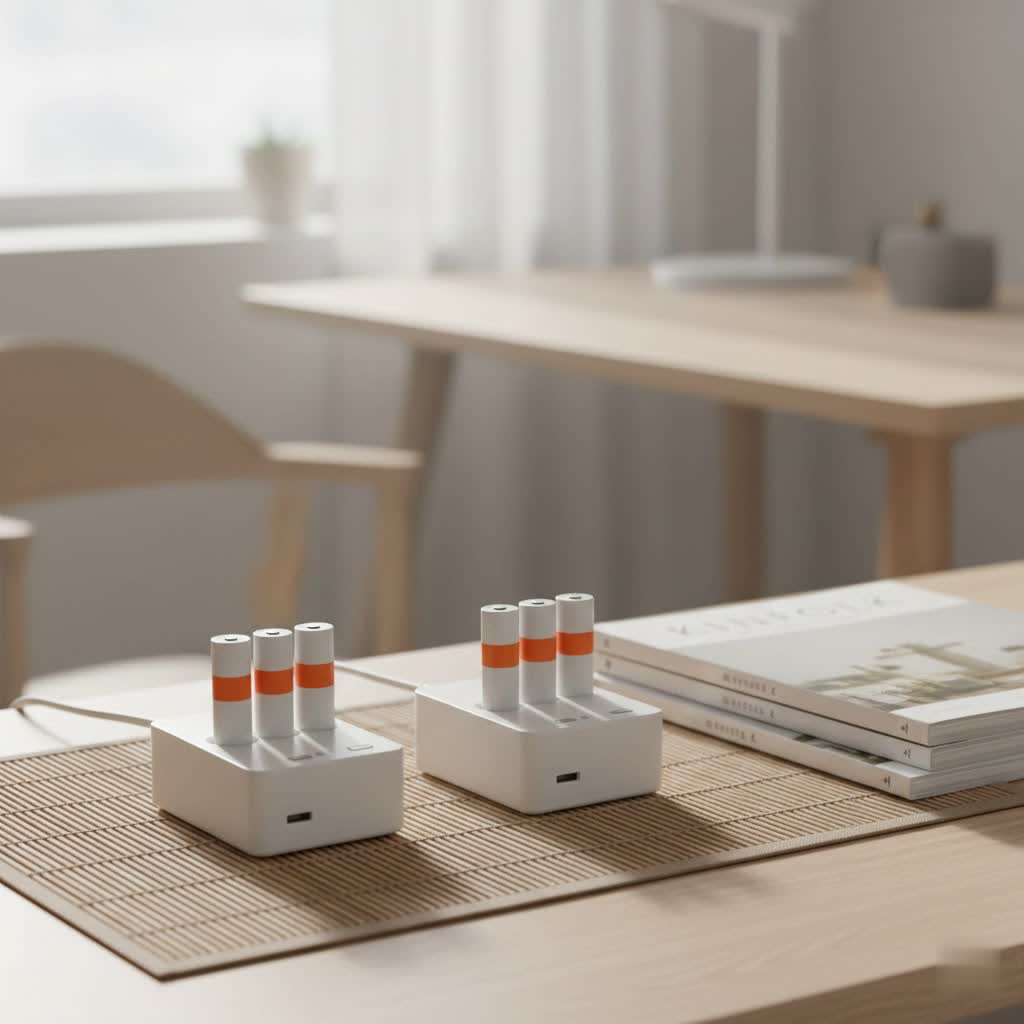
What Makes Eneloop AA Batteries Stand Out?
When Panasonic acquired Sanyo’s Eneloop technology, they didn’t just buy a battery; they invested in a paradigm shift. Unlike traditional NiMH batteries of yesteryear, Eneloop AA batteries redefined what consumers could expect from rechargeables.
Low Self-Discharge (LSD) Technology
|
Our Picks for the Best Rechargeable Batteries in 2026
As an Amazon Associate I earn from qualifying purchases.
|
||
| Num | Product | Action |
|---|---|---|
| 1 | Amazon Basics 24-Pack Rechargeable AAA NiMH Performance Batteries, 800 mAh, 1.2V, Recharge up to 1000x Times, Pre-Charged |

|
| 2 | Amazon Basics 12-Pack Rechargeable AAA NiMH Performance Batteries, 800 mAh, 1.2V, Recharge up to 1000x Times, Pre-Charged |
|
| 3 | Amazon Basics 12-Pack Rechargeable AA NiMH Performance Batteries, 2000 mAh, 1.2V, Recharge up to 1000x Times, Pre-Charged |
|
| 4 | Amazon Basics NiMh Rechargeable Batteries (4 AA & 4 AAA) with 4 Bay Battery Charger, Type A (American) Plug, Black, 8 Count |
|
| 5 | Amazon Basics 24-Pack Rechargeable AA NiMH Batteries, 2000 mAh, 1.2V, Recharge up to 1000x Times, Pre-Charged |
|
| 6 | Amazon Basics 16-Pack Rechargeable AA NiMH Batteries, 2000 mAh, 1.2V, Recharge up to 1000x Times, Pre-Charged |
|
| 7 | EBL AA 2300mAh (8 Pack) and AAA 1100mAh (8 Pack) Ni-MH Rechargeable Batteries and AA AAA Rechargeable Battery Charger with 2 USB Charging Ports |
|
| 8 | POWEROWL Rechargeable AA and AAA Batteries with Fast Charger, High Capacity NiMH - 4 x 2800mAh AA & 4 x 1000mAh AAA |
|
| 9 | Amazon Basics 4-Bay Battery Charger for AA & AAA Rechargeable Batteries with Rechargeable AA NiMh Batteries, 4 count (Pack of 1), Type A (American) Plug, Black |
|
| 10 | EBL 16 Sets AA AAA Batteries Combo with 8PCS AA 2300mAh & 8-Pack AAA 800mAh Rechargeable Batteries |
|
One of Eneloop’s crowning achievements is its incredibly low self-discharge rate. Imagine charging batteries, storing them for a year, and finding them still largely powered up. That’s the magic of Eneloop. Standard Eneloop AA batteries can retain up to 70% of their charge even after 10 years in storage, making them “ready to use” straight out of the package, a convenience unheard of with older NiMH cells. This feature alone transformed how we think about and use rechargeable power.
Ready-to-Use Convenience
Forget the old routine of buying new batteries and immediately needing to charge them. Eneloop AA batteries arrive pre-charged, often by solar energy at the factory, usually holding around 70% of their full capacity. This means you can pop them into your device the moment you open the pack. While a top-up charge before first use is always a good practice to ensure maximum capacity, it’s not strictly necessary.
Consistent Performance
Unlike alkaline batteries, which start at 1.5V and gradually decline, Eneloop NiMH batteries maintain a steady 1.2V output throughout most of their discharge cycle. This consistent voltage ensures that your devices, especially sensitive electronics like digital cameras and flashlights, perform optimally until the battery is nearly depleted, without experiencing performance drops.
Environmental and Economic Benefits
Switching to Eneloop AA rechargeable batteries is a win for your wallet and the environment. While the initial investment might be slightly higher than a pack of alkalines, the ability to recharge Eneloops hundreds, if not thousands, of times translates into significant long-term savings. More importantly, it drastically reduces the waste generated by single-use batteries, minimizing their environmental footprint.
Exploring the Eneloop AA Family: Standard, Pro, and Lite
Panasonic’s Eneloop line isn’t a one-size-fits-all solution; it offers specialized versions to match various power needs. Understanding these distinctions is key to optimizing your battery usage.
Eneloop Standard (White) AA: The Everyday Workhorse
The classic “white” Eneloop AA battery is the flagship for a reason. With a typical capacity ranging from 1900mAh to 2000mAh, these batteries offer an exceptional balance of decent power and remarkable longevity. They are rated for an impressive number of recharge cycles (up to 2100 under older IEC standards, and still robust at around 600 cycles under the more stringent 2017 IEC conditions) and boast excellent charge retention.
What are Standard Eneloop AA batteries best for?
Standard Eneloop AA batteries are your go-to choice for a wide array of everyday electronics, including TV remote controls, wireless keyboards and mice, toys, portable radios, and LED flashlights. Their reliability and long cycle life make them incredibly versatile for general household use where devices don’t demand extreme bursts of power but benefit from consistent energy over time.
Eneloop Pro (Black) AA: Power for the Demanding Devices
For those gadgets that crave more power and demand sustained high performance, the “black” Eneloop Pro AA batteries are your champions. Offering a higher capacity of 2450mAh to 2500mAh, these batteries are designed to deliver more energy in high-drain applications. The trade-off is a slightly reduced cycle life, typically around 500 recharges, and a higher self-discharge rate (retaining about 85% charge after one year compared to the standard Eneloop’s 70% after 10 years).
When should you choose Eneloop Pro AA batteries?
Eneloop Pro AA batteries excel in high-drain devices such as professional camera flash units, high-powered LED flashlights, RC hobby equipment, and gaming controllers. Their ability to quickly replenish power (faster recycle times in flashguns) and provide extended runtime in energy-intensive gadgets makes them indispensable for professionals and serious hobbyists. However, be mindful that their slightly larger diameter can sometimes result in a tight fit in certain battery compartments.
Eneloop Lite (Blue/Grey) AA: The Endurance Champion for Light Loads
The “blue” or “grey” Eneloop Lite AA batteries are specifically designed for applications requiring less power but benefiting from an incredibly long cycle life. With a lower capacity (around 950mAh to 1000mAh for AA), these batteries can endure a staggering number of recharges, often rated for 3000 cycles or more.
Are Eneloop Lite AA batteries right for your device?
Absolutely! Eneloop Lite AA batteries are perfect for very low-drain devices where maximum runtime isn’t the primary concern but longevity and frequent recharging are. Think solar garden lights, clocks, remote controls, and other appliances that sip power slowly. They reduce the initial cost and charging time, proving to be an economical and sustainable choice for these specific applications.
Quick Comparison Table: Eneloop AA Series at a Glance
| Feature | Eneloop Standard (White) | Eneloop Pro (Black) | Eneloop Lite (Blue/Grey) |
|---|---|---|---|
| Capacity (AA) | 1900-2000mAh | 2450-2500mAh | 950-1000mAh |
| Cycle Life | ~600-2100 cycles (IEC-dependent) | ~500 cycles | ~3000+ cycles |
| Self-Discharge | ~70% charge after 10 years | ~85% charge after 1 year | ~90% charge after 5 years (approx.) |
| Ideal For | General use, low-medium drain devices | High-drain devices (flash, gaming) | Very low-drain devices (clocks, remotes) |
| Performance | Balanced, reliable | High power output, faster recycle | Longest cycle life, lower capacity |
Decoding Eneloop AA Specifications: What Do the Numbers Mean?
Understanding the technical specifications helps you choose the right Eneloop AA battery for your needs and ensures proper care.
Understanding mAh (Milliampere-hour): Capacity Explained
mAh, or milliampere-hour, is a unit of electrical charge that indicates a battery’s capacity – essentially, how much energy it can store. A 2000mAh battery, for example, can theoretically deliver 2000 milliamperes of current for one hour, or 100 milliamperes for 20 hours. Higher mAh generally means longer runtime for a device. However, as we’ve discussed with Eneloop Pro, higher capacity can sometimes come with trade-offs in cycle life and self-discharge.
Voltage: The Steady 1.2V Advantage
Eneloop AA batteries, like all NiMH cells, have a nominal voltage of 1.2V. This is slightly lower than the 1.5V of alkaline batteries. While most modern electronic devices are designed to operate perfectly well with 1.2V rechargeable batteries, some older or very voltage-sensitive devices might perform differently. The key advantage of Eneloop’s 1.2V is its stability; it remains remarkably consistent throughout the battery’s discharge, preventing the gradual power fade often seen with alkalines.
Cycle Life: Longevity in Numbers
The “cycle life” refers to the number of times a battery can be recharged before its capacity significantly degrades (typically to 60% or 80% of its original capacity). For standard Eneloop AA batteries, figures like 2100 cycles were common under older IEC testing standards. However, with more stringent 2017 IEC standards that better reflect real-world usage, the official cycle life for standard Eneloop AA batteries is now closer to 600 cycles. It’s crucial to remember that actual cycle life depends heavily on usage patterns, charging habits, and discharge depth. “I’ve personally seen standard Eneloop AA batteries perform reliably for well over a decade in various household applications, far exceeding theoretical cycle counts, simply by practicing good charging habits,” shares Dr. Aris Thorne, a leading expert in battery electrochemistry.
Self-Discharge Rate: Always Ready When You Are
The low self-discharge rate is arguably Eneloop’s most celebrated feature. Traditional NiMH batteries would lose a significant portion of their charge just sitting on a shelf. Eneloop’s advanced chemistry drastically minimizes this, making them practical for everyday use. As mentioned, standard Eneloop AA batteries retain approximately 70% of their charge after a decade, while Eneloop Pro AA batteries still hold about 85% after a year. This means less “battery anxiety” and more convenience, as your charged batteries are almost always ready for action.
Charging Your Eneloop AA Batteries: Best Practices for Longevity
Proper charging is paramount to maximizing the lifespan and performance of your Eneloop AA batteries. Treat them well, and they’ll serve you faithfully for years.
The Importance of a Smart Charger
Not all battery chargers are created equal. For Eneloop AA batteries, a “smart charger” is non-negotiable. These intelligent chargers detect when a battery is full by monitoring voltage drops (-dV/dt termination) or temperature changes, preventing harmful overcharging. Unlike basic “dumb” or “time-based” chargers that simply charge for a set duration, smart chargers protect your batteries and extend their life. Many Panasonic-branded Eneloop chargers (like the BQ-CC65) are excellent smart chargers, offering individual cell charging and clear status indicators.
Recommended Charging Rates (C-rate)
The “C-rate” is a measure of the rate at which a battery is charged or discharged relative to its maximum capacity. For Eneloop AA batteries, a charge rate between 0.5C and 1C is generally recommended. For a standard 2000mAh Eneloop AA, this translates to a charging current of 1000mA to 2000mA. Charging within this range allows the smart charger to accurately detect the full charge point and prevents excessive heat buildup, which is detrimental to NiMH battery health, especially for Eneloop Pro cells.
Avoiding Common Charging Pitfalls
- Ultra-Fast Chargers: While tempting, chargers that promise to fully charge batteries in 15 minutes often use very high currents, leading to excessive heat. This can significantly reduce the cycle life of your Eneloop AA batteries, particularly the more delicate Pro versions. Reserve these for emergencies only.
- Dumb Chargers: As discussed, these charge for a fixed time, often overcharging or undercharging cells, especially if capacities vary. Avoid them.
- Continuous Trickle Charging: Keeping Eneloop AA batteries (especially Eneloop Pro) on a continuous trickle charger, like those often found in DECT phone cradles, can significantly shorten their lifespan. This constant, low-current charge stresses the battery. It’s better to charge them fully and then remove them until needed.
Do New Eneloop Batteries Need Charging Before First Use?
No, not necessarily. Eneloop AA batteries come pre-charged (typically around 70%) and are ready for use right out of the package. However, for maximum capacity and performance from the very first cycle, a full charge before initial use is recommended.
Should You Fully Discharge Eneloops Before Recharging?
No, you don’t need to! NiMH batteries like Eneloop AA do not suffer from the “memory effect” that plagued older Nickel-Cadmium (NiCd) batteries. In fact, consistently deep discharging (below 0.8V) can actually stress the battery and shorten its lifespan. It’s generally better to recharge them when they are partially depleted rather than waiting for them to be completely drained.
How Long Does It Take to Charge Eneloop AA Batteries?
Charging times vary significantly based on the charger model and the capacity of the Eneloop AA batteries. For example, a Panasonic BQ-CC55 smart charger can fully charge standard AA Eneloops (around 2000mAh) in about 1.5 hours. Slower chargers like the BQ-CC17 might take up to 7 hours for the same batteries. Analyser chargers can take even longer, especially if performing refresh cycles. Always consult your charger’s manual for specific timings.
Extending the Life of Your Eneloop AA Batteries: Care and Maintenance Tips
Beyond proper charging, a few simple habits can dramatically increase the longevity of your Eneloop AA batteries.
Preventing Over-Discharge
Over-discharge occurs when a battery is drained beyond its safe voltage limit (typically below 0.8V). This is particularly damaging and can happen in multi-battery devices if one cell is weaker than the others, leading to “reverse charging” of the depleted cell.
Tip: “Always use Eneloop AA batteries in matched sets,” advises Dr. Aris Thorne. “If your device uses four AAs, ensure all four batteries are of the same type, age, and have been charged and discharged together. This minimizes the risk of one battery dragging the others down.”
Proper Storage
Store your Eneloop AA batteries in a cool, dry place, away from direct sunlight and extreme temperatures. While Eneloops perform well in low temperatures, prolonged exposure to high heat can degrade their performance and shorten their lifespan. Avoid storing them completely empty or fully charged for very long periods; around 50-70% charge is ideal for extended storage.
Using Matched Sets
As mentioned, for devices that use multiple AA batteries in series (like many flashlights or toys), always use batteries from the same batch and cycle them together. This ensures even discharge and charge cycles, protecting individual cells from being over-discharged by stronger ones. Limited edition Eneloop packs often come with unique designs, which can be a fun way to keep track of your matched sets.
The “Refresh” Function: Revitalizing Older Cells
Some advanced smart chargers offer a “refresh” or “analyze” function. This mode typically charges the battery, then fully discharges it, and finally recharges it. This process can help break down internal resistance buildup and restore the battery’s maximum possible capacity, effectively “waking up” older or underperforming Eneloop AA batteries. It’s a great practice once or twice a year for heavily used cells.
Eneloop AA vs. Alkaline Batteries: A Clear Winner
For decades, alkaline AA batteries were the default choice. However, when you stack them against Eneloop AA rechargeable batteries, the advantages are clear:
- Performance in High-Drain Devices: Eneloop AA batteries consistently outperform alkalines in high-drain devices, delivering stable power and faster recycle times. Alkalines quickly degrade under heavy loads.
- Cost-Effectiveness: Over their lifespan, Eneloops save you a substantial amount of money. One Eneloop can replace hundreds of alkalines.
- Environmental Impact: Fewer disposable batteries in landfills means less pollution. Eneloop contributes to a more sustainable future.
- Consistency: Stable 1.2V output versus the declining voltage curve of alkalines.
- Leakage: Alkaline batteries are notorious for leaking corrosive chemicals, damaging devices. NiMH batteries like Eneloop are far less prone to leakage.
FAQs about Eneloop AA Rechargeable Batteries
Q: Can I use Eneloop batteries in any device that takes AA batteries?
Most modern devices designed for AA batteries will work perfectly fine with Eneloop AA rechargeable batteries, despite their 1.2V nominal voltage compared to alkaline’s 1.5V. However, some very old or highly voltage-sensitive devices might perform sub-optimally or show “low battery” warnings prematurely. Always check your device’s manual if unsure.
Q: How can I spot fake Eneloop AA batteries?
Counterfeit Eneloop AA batteries are unfortunately a reality. Look for inconsistencies in packaging, printing quality, and battery wrapper details. Authentic Eneloop Pro batteries are always made in Japan. Check the product codes (e.g., BK-3HCD for AA Pro) and purchase from reputable retailers to avoid fakes.
Q: What is the average lifespan of Eneloop AA batteries?
With proper care, standard Eneloop AA batteries can last 10 years or more. Eneloop Pro AA batteries, due to their higher capacity and higher current demands, typically have a shorter lifespan of around 5 years, though this can vary greatly based on usage and charging practices.
Q: Are Eneloop batteries truly environmentally friendly?
Yes, they are significantly more environmentally friendly than disposable alkaline batteries. By reducing the number of batteries purchased and subsequently discarded, Eneloop AA batteries help minimize chemical waste and resource consumption associated with battery production and disposal. Many are also pre-charged using solar energy.
Q: What is the “memory effect” and do Eneloops suffer from it?
The “memory effect” was a phenomenon primarily associated with older NiCd batteries, where repeated partial discharges followed by recharging could cause the battery to “remember” the shallower discharge point, leading to a reduced usable capacity. Fortunately, NiMH batteries, including all Eneloop AA series, are virtually immune to the memory effect. You can recharge them at any state of discharge without fear of damaging their capacity.
Conclusion
Eneloop AA rechargeable batteries represent a pinnacle in portable power technology, combining convenience, high performance, and environmental responsibility. Whether you opt for the versatile Standard, the powerful Pro, or the ultra-long-lasting Lite, there’s an Eneloop AA battery perfectly suited for your needs. By understanding their characteristics and adhering to best charging and care practices, you’re not just investing in reliable power; you’re making a conscious choice for smarter, more sustainable living. Join the Kiedl community in embracing these fantastic cells and share your experiences – let’s power a better tomorrow, one Eneloop at a time.
